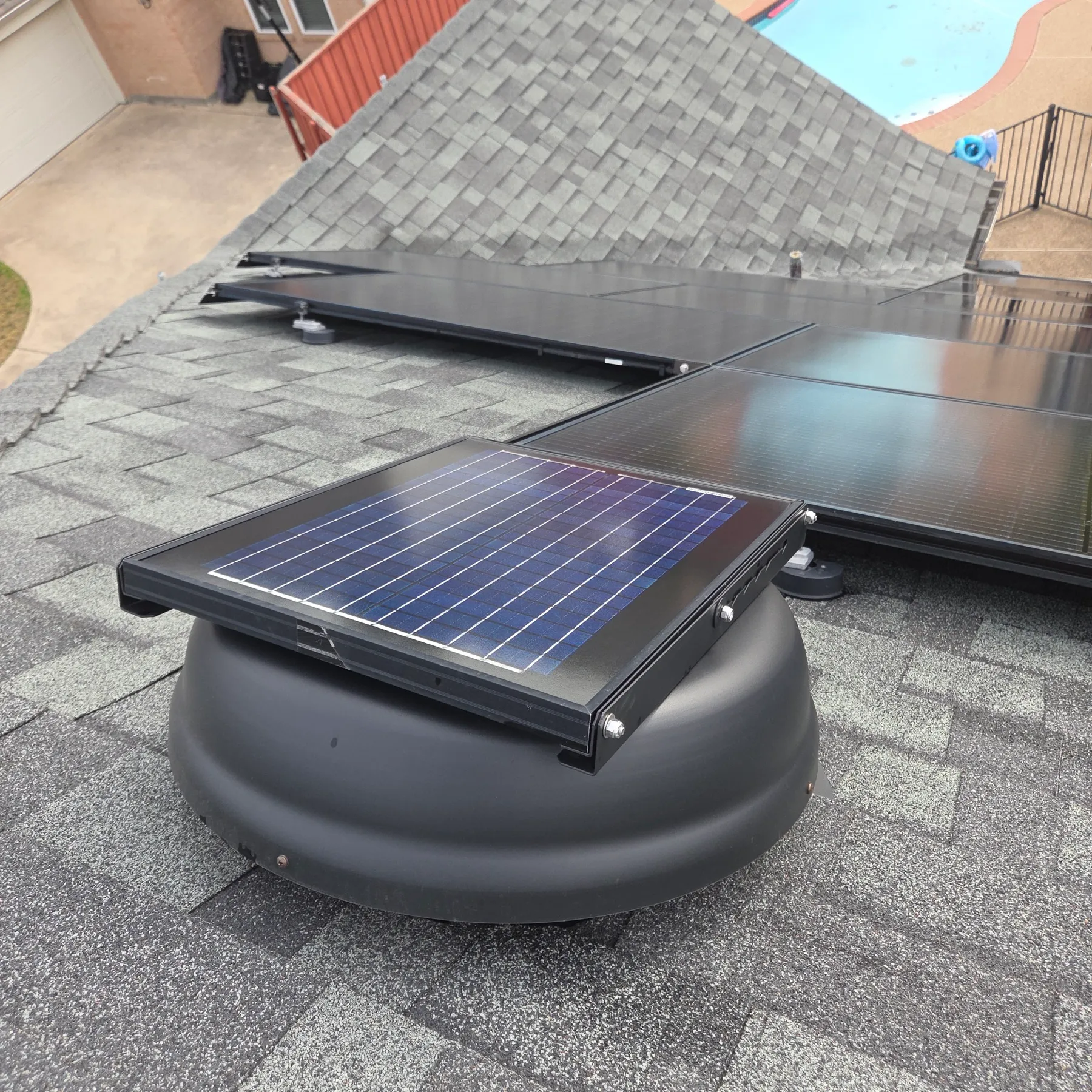
Improve attic airflow and upstairs comfort
Solar Attic Ventilation Fans
Solar-powered attic fans that exhaust trapped hot air using sunlight instead of household electricity — sized to your attic square footage and existing vents.
- Power
- Integrated solar panel
- Sizing guide
- Roughly one fan per 1,000–1,200 sq ft of attic
- Mounting
- Roof-mounted, sealed and flashed
- Night operation
- Only on models with a battery or grid bridge
Why it matters
What attic ventilation actually does for you
Targets hot upstairs rooms
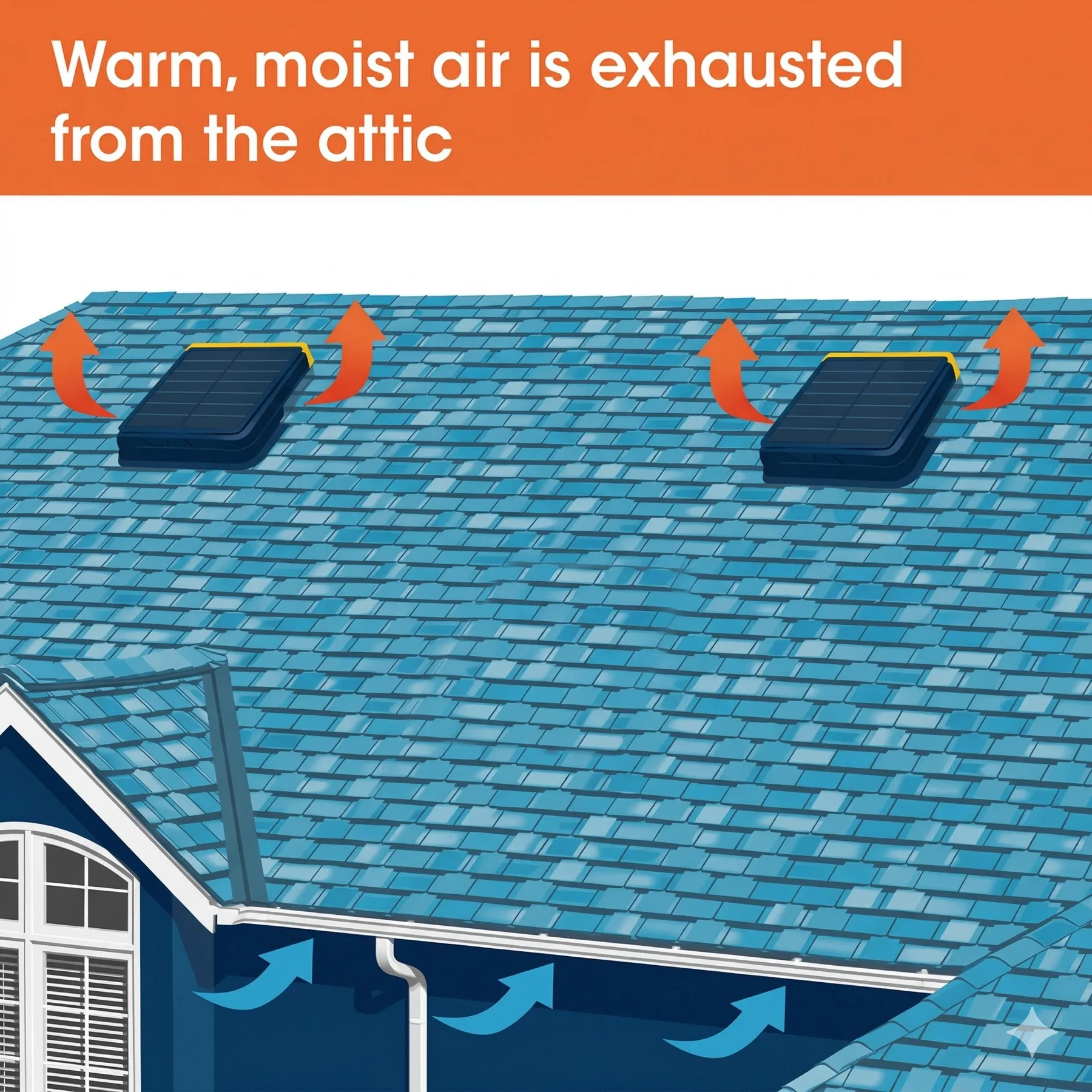
A trapped attic radiates heat down through the ceiling all afternoon. Exhausting that air is the first thing to try.
Runs on sunlight
The fan draws from its own PV panel, so it does not add to your household electric load.
Helps with winter moisture too
Airflow reduces the condensation that collects on cold rafters and leads to mildew and wood rot.
Quiet and low-maintenance
No ductwork, no wiring runs into the house, and nothing to service on a schedule.
The problem
A trapped attic radiates heat down all afternoon
On a North Texas summer day, an unventilated attic gets far hotter than the air outside and holds that heat well past sunset. The ceiling below it becomes a radiator pointed at your bedrooms.
What that feels like downstairs
- Upstairs bedrooms that never match the thermostat downstairs
- The AC running long into the evening after a hot day
- An attic that feels stifling and smells stale year-round
- Condensation or dark staining on rafters in winter
Not just summer
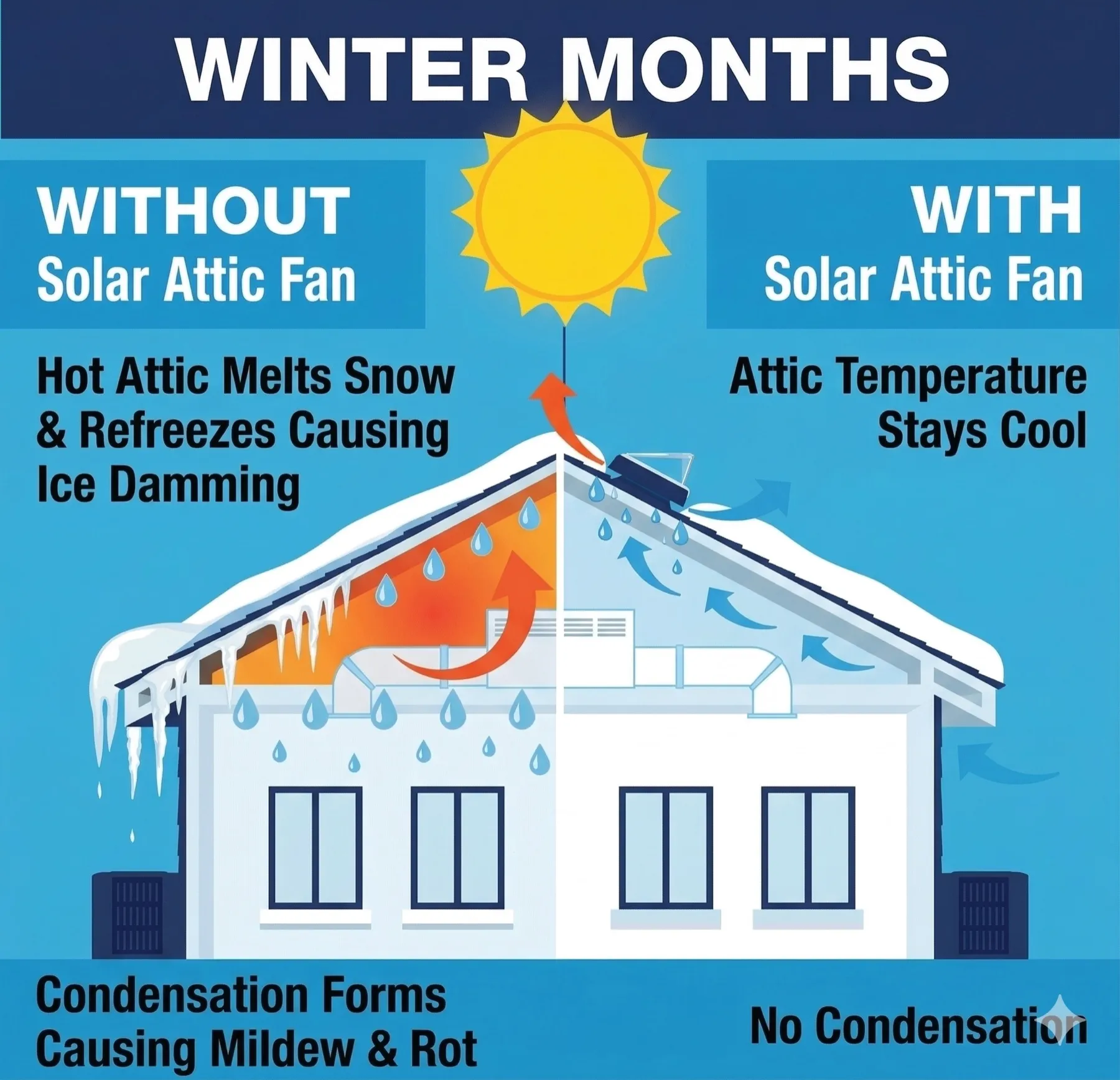
Winter is a moisture problem, not a heat problem
Warm, damp air from the house rises into the attic all winter. With nowhere to go, it condenses on cold rafters — and that is where mildew and wood rot start.
Airflow keeps that moisture moving out instead of settling. It is the less obvious half of why attic ventilation matters, and it is the half that quietly costs you a roof deck.
Ice damming is a real failure mode of a hot attic, though it matters far more in colder climates than it does in Collin County. We mention it for completeness, not as a scare.
Straight answers
What a solar attic fan will and won't do
This is a complementary comfort upgrade, not a miracle. Here is where we draw the line.
- Will it cut my power bill?
- It reduces how hard your AC works, which usually shows up somewhere. How much depends on your insulation depth, existing intake venting, duct condition, and thermostat habits. Continuous airflow also prevents moisture rot and ice dams, preserving your roof structure and shingles — and upstairs comfort is the change people notice first.
- Is a fan enough on its own?
- Not always. A fan is exhaust, and exhaust needs intake. If the soffit vents are blocked, painted over, or undersized, adding a fan pulls conditioned air out of the house instead of hot air out of the attic. We check intake before recommending anything.
- Will it fix a poorly insulated attic?
- No. Ventilation and insulation solve different problems. If the real issue is thin or displaced insulation, a fan will help less than fixing the insulation, and we will tell you that.
The install
Roof-mounted, sealed, and running the same day
The fan draws from its own integrated PV panel, so nothing gets wired back into the house and nothing is added to your electric load.
- We check existing intake venting before recommending a fan
- Sized roughly one fan per 1,000–1,200 sq ft of attic
- Mounted on the appropriate roof slope for sun exposure
- Flashed and sealed to the same standard as any roof penetration
- Positioned to work with your array, not shade it or crowd it
- Roof mount or gable mount — homeowners comparing product lines such as Solatube will find the best choice depends on fit, airflow needs, and installation conditions rather than the label
- No ductwork, no household wiring, no scheduled maintenance
How it works
What the visit looks like
Inspect, recommend, do the work, review it with you. No surprises added at the end.
Inspect
We get on the roof and look at what is actually happening — array perimeter, nesting activity, glass condition, attic venting. Photos included.
Recommend
You get a written estimate that says what we would do and what it costs. If you do not need the work yet, we will tell you that instead.
Install or service
We do the work on the agreed date, protect the roof and the modules while we are up there, and clean up after ourselves.
Review
We walk you through what we found and what we did, and tell you what to watch for so you know when to call us again.
- Fully insured & bonded Licensed and insured in Texas
- Family-owned A Texas business serving Collin County
- Eco-friendly products No harsh chemicals, ever
- 5-star reviewed Verified Google reviews
Straight answers
Solar Attic Ventilation Fans questions
Will a solar attic fan lower my electricity bill?
It can reduce how hard your air conditioning works by exhausting trapped hot air before it soaks into your ceiling. How much that shows up on a bill depends on your insulation, existing ventilation, ductwork, and how you run your thermostat. Continuous airflow also prevents moisture rot and ice dams, preserving your roof's structural integrity and shingles for the long term.
How many attic fans do I need?
A common starting point is one fan per 1,000 to 1,200 square feet of attic space, adjusted for your roof design and the intake venting you already have. Fans need somewhere to pull air from — if the soffit intake is blocked or undersized, adding exhaust alone will not do much.
Do they run at night or on cloudy days?
Standard solar attic fans run when sunlight is hitting their panel, and many keep turning in overcast conditions at reduced speed. They generally do not run at night unless you choose a model with battery backup or a solar-to-electric bridge. We will tell you which type you are looking at before you buy.
Do I need attic ventilation in winter?
Airflow still matters in winter. Warm, moist air from the house rises into the attic, and without ventilation it condenses on cold rafters, which is what leads to mildew and wood rot over time.
Free estimate
Get a attic ventilation quote
Answer three quick questions and we'll come take a look. Written estimate, no obligation.
Not sure what your roof needs?
Book a solar protection inspection. We'll look at the array, tell you what we see, and put a written estimate in your hands — no pressure, no obligation.